
MIT Press
Review by David Starkey
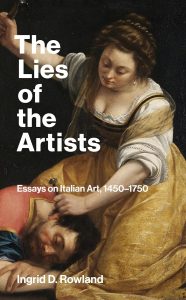
The Lies of the Artists is a clever title for a book with the subtitle Essays on Italian Art, 1450-1750, but it seems to promise, as suggested on the book’s back cover, an exposé of the artists’ “seemingly miraculous ways of transforming transcendent ideas into tangible works of art that challenged and redefined reality, ‘lies’ with the power to reveal a deeper truth.” It’s a fascinating premise, but I don’t believe it’s one that author Ingrid Rowland delivers.
It’s not that Rowland, a history professor at the University of Notre Dame, doesn’t know her stuff. Each chapter succinctly and accurately describes the life and work of the artist under consideration, often with the help of telling anecdotes. I never once thought, No, you’ve got that all wrong. However, unless the book’s argument is simply that, because it’s not “real,” all art is basically a “lie”—and that’s hardly a groundbreaking thesis—Rowland doesn’t really focus on how craft might be considered an untruth. Instead, she shows us how skillful each artist is by carefully describing their practice.
Look, for instance, at her chapter on “Sublime, Exhilarating Andrea del Sarto.” In her discussion of his Holy Family, Rowland compares an infrared image of the painting’s beginnings with the finished work:
the detailed red chalk drawing of a wizened elderly woman looks very much like Andrea’s underdrawing for the figure of Saint Elizabeth on the painting itself. But the features of the Saint Elizabeth we see in the final painting have been smoothed and softened, her face turned into a more perfect oval, her wrinkles blurred. The unblinking detail of the drawing has been transformed into an ethereal vision. This gauzy, ethereal softness seems to be one of the ways that Andrea del Sarto identifies his holy figures as belonging to another realm.
This is a sensitive and astute description of the painting, but it doesn’t imply that Andrea del Sarto is in any way deceiving viewers—he’s simply employing all his talents as an artist to render his subject as emotionally powerful as possible.
If I’ve spent time fussing over what feels like an errant title, it’s largely because it doesn’t do justice to such an enjoyable book. Rowland covers the essential artists from her chosen time period that one might expect—Raphael, Michelangelo, Titian, Tintoretto, Caravaggio, Artemisia Gentileschi, and Bernini—but she also spends time with the early Renaissance sculptor Bertoldo di Giovanni and painter Antonello da Messina. Both chapters help prepare us for the great explosion of creativity that was too follow.
In fact, I kept underlining particularly insightful or felicitous passages. Describing Titian’s Danaë, which was stored in a “Pornographic Cabinet” by the King of Naples, Rowlands writes: “The sensuality of that locked-away painting…is a good deal more discreet than that of other frankly sexual objects: imprisoned in her chambers, she reclines on her bed as Jupiter appears to her in a shower of heavenly gold that pours into her lap.” Of Michelangelo: he “carved stone with matchless speed and facility, but the fact that he shaped his work instinctively rather than by careful advance preparation led him into trouble as well as success; his studio was filled with half-finished projects, some of them impossible to complete, some of them familiar if silent friends.” There’s a richness and a density to her observations, which is not surprising, considering how compact the chapters are. The one on Michelangelo, for example, is just eight pages long.
The Lies of the Artists ends, appropriately, with a chapter on Giorgio Vasari’s book Live of the Artists. Rowland says of Vasari, that he “saw learning, like technical expertise, as something to be shared rather than hoarded, especially, when it involved telling a good story,” and that sounds a great like like Rowland’s project in this book. At the end of Lies of the Artists, she quotes from Vasari’s final chapter, ending on a sentence she might have written herself: “As for the rest, having done what I could, please accept it willingly, and don’t ask me for what I don’t know and can’t do, taking satisfaction in my good intentions, which have been, and ever shall be, to help and please others.”