
Chicago
Review by David Starkey
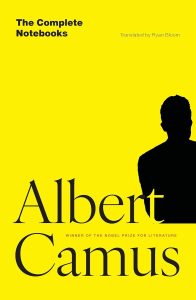
Is Albert Camus’s most famous novel, The Stranger, a bit too programmatic? Is The Plague, which I reviewed during COVID, a bit too long? Is the metaphor of his essay “The Myth of Sisyphus” a bit too pat? Honestly, I don’t know. Maybe. But Camus, winner of the 1957 Nobel Prize in Literature, and who died in an auto accident in 1960 at the age of 46, is certainly one hell of a diarist.
The Complete Notebooks, translated with an introduction by Ryan Bloom, begin in May 1935 and extend until before his death, where the dating becomes uncertain. But whether as a young man in his early twenties, or a world-renowned globetrotting writer, Camus has a rare gift for both description and aphorism.
Of the former, here he is in August 1942, describing the passengers on a local train: “old peasant couples, she papery, with a smooth face, he with two light-colored eyes and a white mustache—silhouettes wrung out by two winters of deprivation, dressed in glossy, patched-together clothing. Elegance has abandoned these people in whom poverty dwells. The briefcases on the train are tattered, held shut with twine, patched up with cardboard. All French people look like emigrants.”
And, as in the journals of Emerson, of whom Camus was an admirer, you can open to just about any page and find something memorable. Here are just few examples: “Why am I an artist and not a philosopher? Because I think in words and not ideas.” “Tragedy is not a solution.” “God didn’t create himself. He’s the son of human pride.” “All great virtues have an absurd side.” “Despicable is the writer who speaks to exploit what he’s never lived.” “Annihilation can’t frighten a person who’s lived a full life.”
The notebooks are also repositories of ideas for his fiction, nonfiction and drama, and so there are passages of dialogue and thoughts on plot and characters, as well as reminders of pieces he wants to write. Sometimes he thinks through a potential work in some detail; other times he is quite brief: “A short story that will take place on a day of yellow fog.” And: “An essay on alibi.”
Camus’s was an extraordinarily eventful life, and there are references to people and events that no one but a Camus scholar might find obvious. Fortunately, Bloom does an excellent job with his footnotes, which are both concise and judiciously selected. A quick glance at the bottom of the page can clear up most confusion, but, overall, notes aren’t really needed: Camus’s writing stands on its own.
The nine notebooks collected here, along with a journal of Camus’s travels in South America, have been published separately over the years, but many of them are out of print, and earlier editions can be ridiculously expensive. What a treat, therefore, it is to have them all together for one’s reading pleasure. And Camus did want them to be read. As Bloom points out, the first seven were typed out by Camus’s secretary because Camus’s handwriting “is incredibly difficult to read.” And Bloom acknowledges that one of the reasons Camus’s notebooks are so compelling is because he spent so much time on them. Bloom quotes Camus’s biographer Olivier Todd, that the author “really wasn’t one for first drafts…[he] liked rewriting as much as the initial writing itself.”
I feel a bit sheepish saying it, but my favorite book of 2026 so far is one written by an author who died before I was born. The Complete Notebooks is a gem.